Introduction
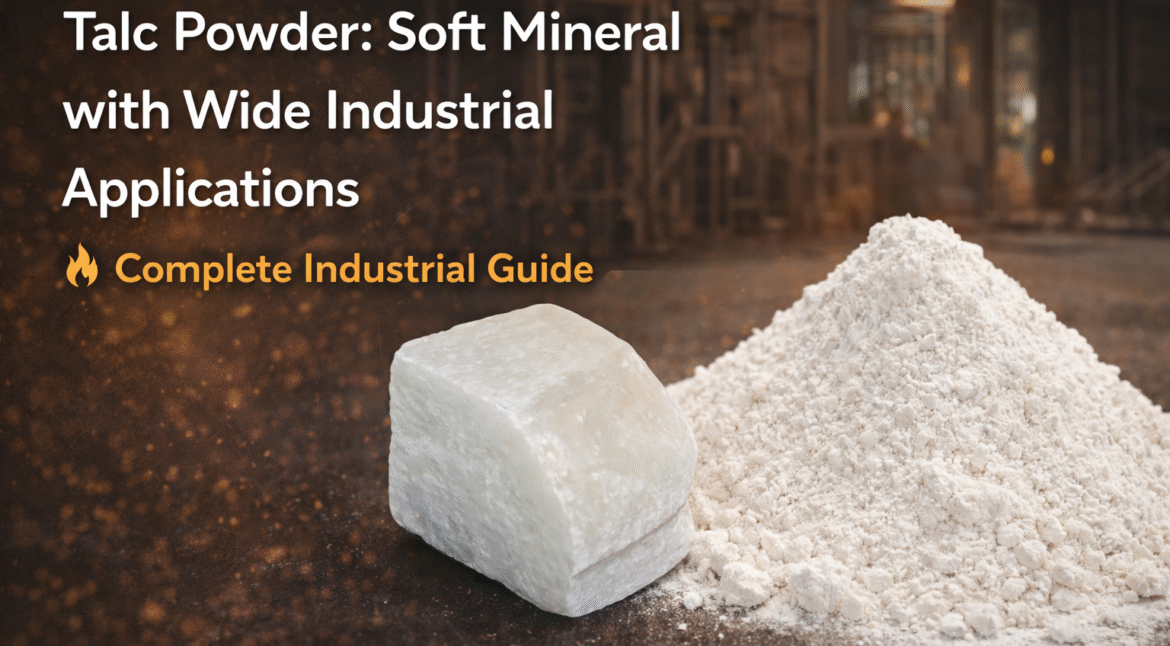
Talc powder is one of the most versatile industrial minerals, known for its softness, smooth texture, and wide range of applications. It plays a crucial role in industries such as plastics, paints, paper, cosmetics, and ceramics.
Due to its unique physical and chemical properties, talc powder enhances product quality, improves performance, and supports efficient manufacturing processes. This article provides a complete overview of talc powder, its features, applications, and industrial importance.
What is Talc Powder?
Talc powder is a naturally occurring mineral composed primarily of magnesium silicate (Mg₃Si₄O₁₀(OH)₂). It is the softest mineral on the Mohs hardness scale, making it easy to process into fine powder.
Its smooth texture, chemical stability, and moisture-absorbing properties make it suitable for a wide range of industrial uses.
Key Features of Talc Powder
- Ultra-Soft Texture: Known for its smooth and fine feel
- High Whiteness: Ideal for applications requiring bright finish
- Excellent Absorbency: Helps in moisture control
- Chemical Inertness: Does not react easily with other substances
- Thermal Resistance: Performs well in high-temperature processes
Industrial Applications of Talc Powder
1. Plastics Industry
Used as a filler to improve stiffness, durability, and heat resistance in plastic products.
2. Paints & Coatings
Enhances smoothness, coverage, and durability of paints.
3. Paper Industry
Improves brightness, printability, and surface finish.
4. Ceramics
Used to enhance strength and thermal resistance in ceramic products.
5. Cosmetics & Personal Care
Widely used in products like powders and skincare items due to its softness and absorbency.
6. Rubber Industry
Improves processing and enhances product quality.
Processing & Manufacturing of Talc Powder
The production of talc powder involves several stages:
- Mining – Extraction of raw talc from deposits
- Crushing – Breaking down into smaller pieces
- Grinding – Converting into fine powder
- Classification – Separating particles based on size
- Purification – Removing impurities
- Packaging – Supplying in clean and moisture-free packaging
Proper processing ensures consistent quality and fine particle size.
Importance of Quality in Talc Powder
High-quality talc powder ensures:
- Smooth texture and uniform consistency
- Better performance in industrial applications
- High brightness and purity
- Reduced impurities and defects
- Improved end-product quality
How Reliable Suppliers Add Value
Consistent Quality
Maintaining uniform particle size and composition across batches.
Customized Grades
Providing different mesh sizes and specifications based on industry needs.
Bulk Supply Capability
Ensuring continuous availability for large-scale operations.
Technical Support
Helping industries choose the right grade for specific applications.
Conclusion
Talc powder is a highly valuable mineral that supports a wide range of industrial applications. Its softness, chemical stability, and versatility make it an essential material in manufacturing and processing industries.
Choosing high-quality talc powder ensures better product performance, improved efficiency, and long-term reliability. For industries that demand precision and consistency, talc powder remains an indispensable resource.
We are a trusted talc powder supplier and manufacturer in Saudi Arabia.offering high-purity talc with fine particle size and excellent performance for various industrial applications. Our talc is processed using advanced techniques to ensure smooth texture, low impurities, and consistent quality.
Our talc powder is widely used in plastics, paints, paper, ceramics, cosmetics, and pharmaceutical industries across Saudi Arabia. With reliable supply, bulk availability, and efficient logistics, we ensure timely delivery and dependable quality to meet diverse industrial requirements throughout Saudi Arabia.
We are a trusted talc powder supplier and manufacturer in Doha, Qatar. offering high-purity talc with fine particle size and excellent performance for various industrial applications. Our talc is processed using advanced techniques to ensure smooth texture, low impurities, and consistent quality.
Our talc powder is widely used in plastics, paints, paper, ceramics, cosmetics, and pharmaceutical industries across Doha, Qatar. With reliable supply, bulk availability, and efficient logistics, we ensure timely delivery and dependable quality to meet diverse industrial requirements throughout Doha, Qatar.
We are a trusted talc powder supplier and manufacturer in Muscat, Oman. offering high-purity talc with fine particle size and excellent performance for various industrial applications. Our talc is processed using advanced techniques to ensure smooth texture, low impurities, and consistent quality.
Our talc powder is widely used in plastics, paints, paper, ceramics, cosmetics, and pharmaceutical industries across Muscat, Oman. With reliable supply, bulk availability, and efficient logistics, we ensure timely delivery and dependable quality to meet diverse industrial requirements throughout Muscat, Oman.
We are a trusted talc powder supplier and manufacturer in Dubai, UAE. offering high-purity talc with fine particle size and excellent performance for various industrial applications. Our talc is processed using advanced techniques to ensure smooth texture, low impurities, and consistent quality.
Our talc powder is widely used in plastics, paints, paper, ceramics, cosmetics, and pharmaceutical industries across Dubai, UAE. With reliable supply, bulk availability, and efficient logistics, we ensure timely delivery and dependable quality to meet diverse industrial requirements throughout Dubai, UAE.